DuckDuckGo could be your new default search engine if you want to focus on privacy and security. What it’s like using it nowadays?
You might have heard of DuckDuckGo in the past. Our first long post about it was back in 2016 with Rebecca Sentance trying out the new search engine for a week.
Three years later, many things have changed. More users are losing trust in big tech companies and privacy and security are more important than ever. How does DuckDuckGo fit in this change?
And how is the experience of switching into a new search engine nowadays?
DuckDuckGo in numbers
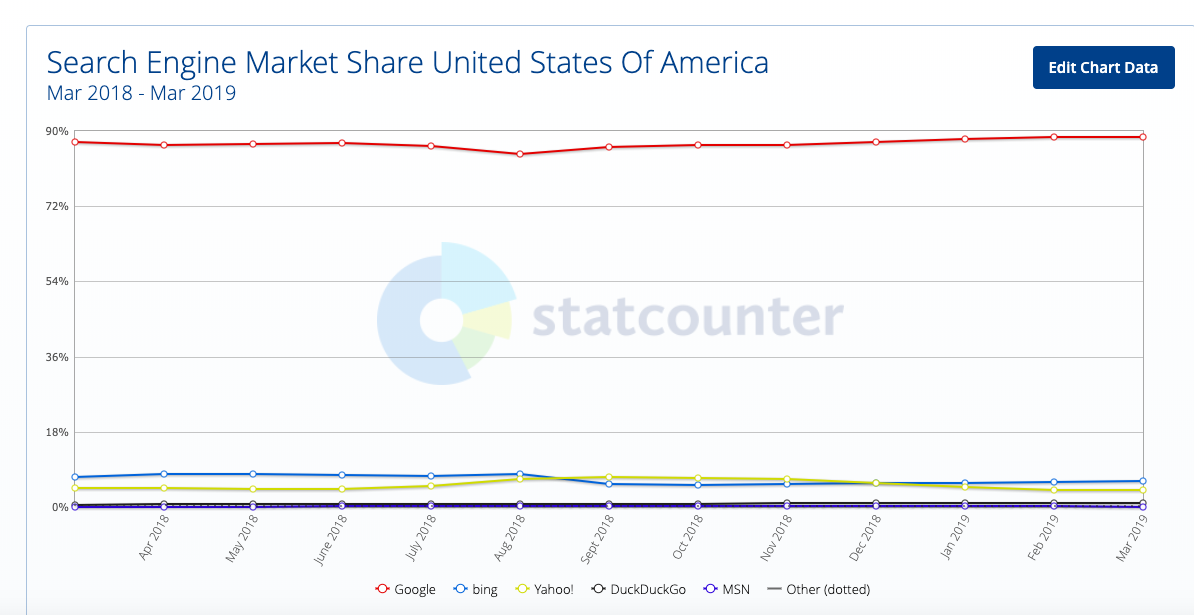
Over the last few months, DuckDuckGo has seen increased media coverage. Its growing stats among a growing conversation around online privacy make it more relevant than ever.
There are more than 30 million searches happening on DuckDuckGo every day. Its data indicates a constant growth. It’s currently the fourth largest search engine in the U.S. counting more than 1 billion searches every month all over the world.
Google is holding the reins of the market share with 88.5% of it, Bing is following with 6.12%, Yahoo! is third with 4.11% and DuckDuckGo is forthwith 0.99% of the market share.
It clearly has a long way to go to stand out as a serious competitor in the market share. However, it has already paved the way in a new kind of search engine that is serious about security and privacy. In fact, its mission is to set a new standard of trust online.
The search engine that doesn’t track you
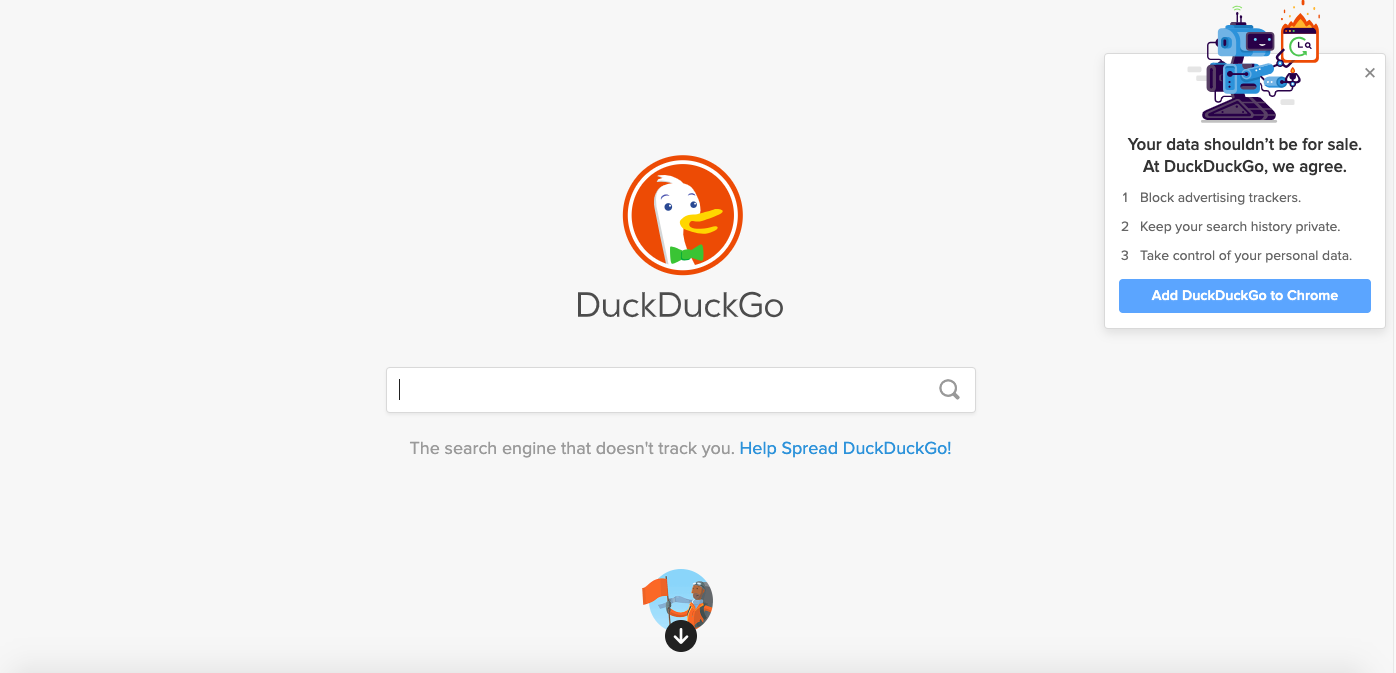
One of the first things you notice when visiting DuckDuckGo, except for the search box, is the subheading “the search engine that doesn’t track you”.
DuckDuckGo was built as an alternative to Google and the big search engines that use tracking data to improve personalization. DuckDuckGo reassures its users that they don’t store their personal information. They don’t collect or share personal data. They are not storing your search history, which means that they are not able to sell this data to advertisers. Moreover, there’s no tracking in the private browsing mode, which sounds encouraging for everyone who is interested in a search engine that won’t track every single search.
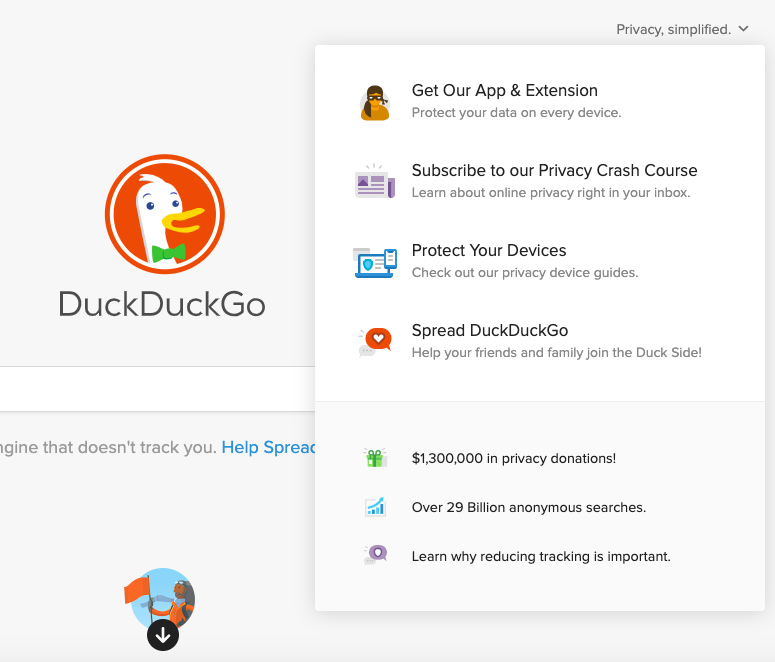
What’s interesting is that DuckDuckGo wants to prove that they take privacy seriously. A click on their menu button at the homepage on ‘privacy simplified’ allows you to:
- Protect your data on every device
- Subscribe to their Privacy Crash Course to improve your understanding of online privacy
- Protect your devices by reading privacy guides
- Find out more about the importance of reduced tracking
Just recently, Google announced an expanded number of default search engines for users including DuckDuckGo for the first time. This was certainly a small win for the DuckDuckGo and also for people who want to focus on private searches.
It’s not surprising that more users are interested in learning more about their online privacy.
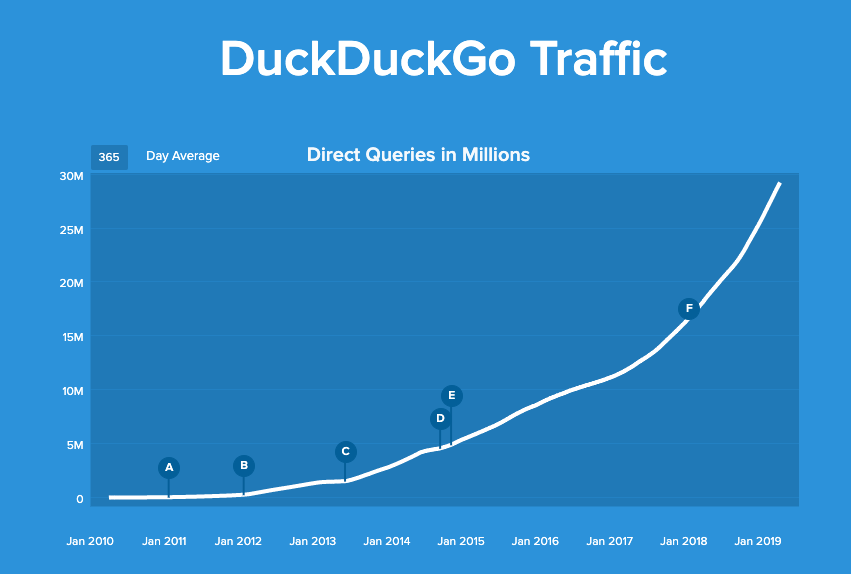
[Screenshot from DuckDuckGo’s traffic page.]
A closer look at DuckDuckGo’s stats indicates this growing interest in security and privacy. DuckDuckGo reached 10 million searches in one day back in 2015. It managed to reach 20 million searches in October 2018. In April 2019 it counts 38 million searches.
Making the most of DuckDuckGo
I’ve decided to try out DuckDuckGo after many years of using Google. The focus on online privacy along with the growing number of people switching to DuckDuckGo made it an intriguing choice.
The first impression seemed familiar. Simplicity and a minimal interface made the transition easy.
The fact that your searches are not personalized means that everyone can access the same results in a similar search. This seems to be a relief in the common pattern of the online filter bubbles that we’re used to be part of.

Another relief was the lack of endless ads before the actual search results. I’ve been used to the series of ads before the actual search results and the science of PPC from a professional perspective, but it was still a nice experience to find the direct results of my query. There was only one ad at the top of the search results, which I certainly wouldn’t mind seeing a similar limit to my Google results.
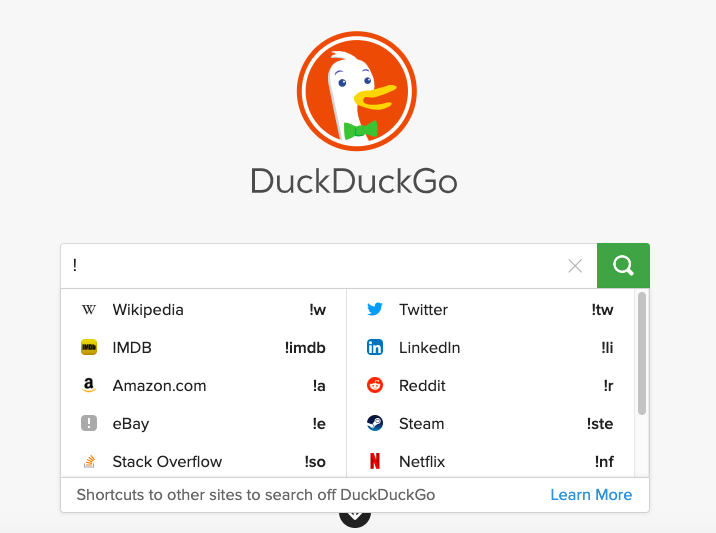
In addition to these, you can also save time from your searches by making the most of DuckDuckGo’s bangs. Bangs are shortcuts that allow you to search results on other sites. If you want to search for “SEO” on Search Engine Watch and you’re actually on DuckDuckGo’s homepage, all you need to do is to type ‘!searchenginewatch seo’
There are currently more than 12k bangs so you can search any of the big sites without visiting them in a different tab.
Finding the best search results — not everything is perfect
I must admit that the lack of personalization has its pros and cons. It is obviously reassuring to feel that you’re in control of your own data. However, you should also be prepared for the additional queries you might need to find the best results.
Forget queries like “cinemas near me” and “what’s playing”

The search results will be the same for everyone all over the world without detailed queries that could possibly help you get more personalized results.
Moreover, the actual search cannot compete with Google’s sophisticated search. After years of serving as the biggest search engine, there is a learning of semantics that leads to way better results compared to all other search engines.
This shouldn’t be a surprise and it should be clear when you’re jumping into DuckDuckGo that not everything will be the same.
There will also be an initial phase of learning the ropes of a new search experience, which is expected in every new tool and site.
Are these reasons enough to abandon DuckDuckGo? Not yet. It’s good to understand that it won’t replace Google anytime soon but this doesn’t mean that it doesn’t deserve a chance, especially if you’re serious about your online privacy when searching. I’ll personally give it a go knowing that if I can’t find a specific result, I can still use Google. I also enjoy their curated stories around privacy on their Twitter feed so it was an easy decision to follow them and stay up-to-date.
The choice is yours

The online world is changing. And we’re facing with numerous dilemmas when it comes to staying loyal to the big tech companies. As more data breaches and scandals show up, it’s up to us to decide whether we want to keep personalization or not.
There’s no right or wrong answer.
Google is certainly enjoying the success of the big search giant with a large index and search features that keep us hooked with along the numerous services we use on a daily basis. However, it’s refreshing to feel that we still have alternative options. Whether we use them or not, it’s up to us.
What’s important is to be conscious of your decision and your online privacy. The more informed we are, the better our online experience.
The post What’s it like using DuckDuckGo in 2019? appeared first on Search Engine Watch.
from Search Engine Watch http://bit.ly/2W12yzL
Comments
Post a Comment